
Training Philosophy
I AM THE SOURCE
I am the origin of all meaningful experiences in my dogs’ lives. I regulate opportunities for movement, rest, nourishment, social engagement, play, and exploration, all drivers of dopamine release and emotional regulation.
I provide the predictability, discipline, and energy that supports behavioral stability and psychological safety. I condition ease with confinement, resilience during isolation, and the ability to remain regulated in the presence of stressors and triggers.
By consistently channeling reinforcement through me, dogs look to me first for feedback and guidance. This orientation toward me is not only fundamental to their behavioral success. It is essential for their survival and long-term well-being.
With over 30 years in professional dog training, I’ve had the rare opportunity to explore nearly every approach to training and rehabilitation. My journey began with the only tool we had for pet dogs at the time. The choke chain. My experience began to evolve in 1997 when I was introduced to B.F. Skinner’s Operant Conditioning through his graduate student, Marion Breland Bailey. I had the privilege of training under Marion and Bob Bailey in their renowned “Chicken Clicking Course,” where I honed my skills using the clicker for positive reinforcement training.
I spent several years immersed in the world of positive reinforcement, often referred to as “Purely Positive” or “Force Free,” and earned certification through the Certification Council for Professional Dog Trainers (CCPDT), which I held until 2013. As my personal pack grew to include more complex, challenging dogs, so did the scope of my work. I began supporting owners who needed their dogs to accompany them off-leash into the rugged Montana backcountry, where encounters with grizzlies and moose were real possibilities. I also started receiving referrals for severe aggression cases from across Montana and neighboring states.
This evolving work required me to expand my toolbox beyond any one method or philosophy. I adapted my approach to meet the real-world needs of the dogs in my life, and the dogs that my client’s were trying to help. By 2025, I’ve worked with thousands of dogs and have supported clients through some of the most difficult and nuanced behavior cases out there.
I remain deeply committed to staying open-minded. I believe every training tool, when used thoughtfully and skillfully, has value. I continuously experiment and refine my approach with my own dogs, a revolving pack that sees new members almost weekly. This constant exposure has allowed me to recognize subtle patterns in behavior that are breed-specific, gender-specific, even coat and color-specific, and I regularly advise clients on which dog breeds may best suit their household and lifestyle.
I don’t use a one-size-fits-all formula. Instead, I assess every dog and human as individuals and create a custom path forward, one that ensures safety and peaceful co-existence. My own life with dogs is raw and real. I hike off-leash with up to 17 dogs together daily through rough terrain. I guide them through the complex dynamics of sharing high-value resources, help them navigate social interactions, and recognize which dogs enjoy public engagement and which prefer the predictable safety of home.
The conversation about your dog, and your relationship with them, goes far beyond obedience. It’s a deeper understanding of yourself and your perception of the ethos of the dog. What is yours and what is theirs.
All of the questions ultimately lead to the final question. What is a Dog?
Dog Training
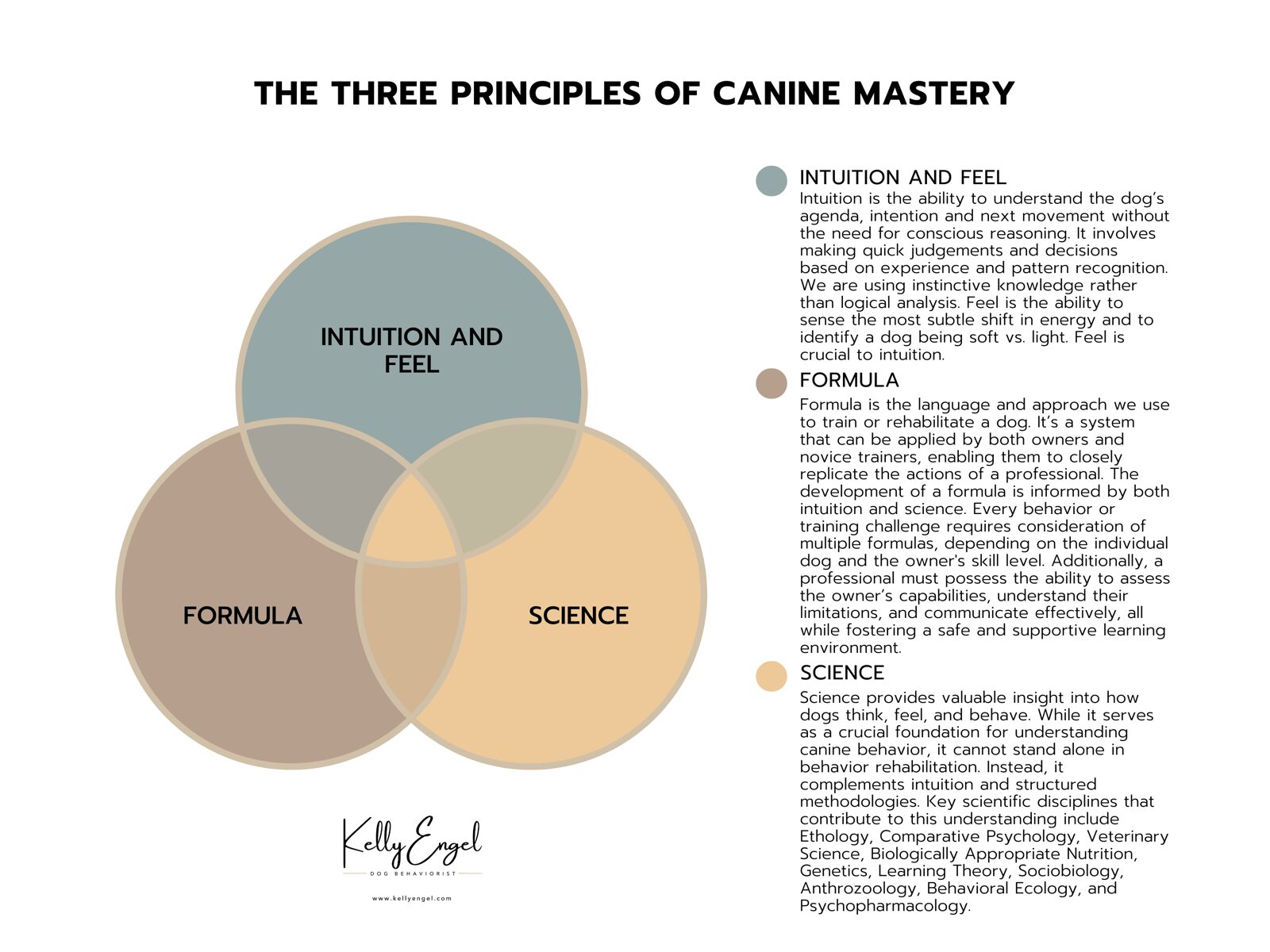
I developed and hold the copyright to the Three Principles of Canine Mastery. This Venn diagram serves as a conceptual framework for evaluating professional competence in the field of canine behavior. It illustrates the dynamic interplay between intuition and feel, structured formula, and scientific knowledge. By using this model, practitioners can critically assess their strengths and identify areas for continued growth, allowing them to provide more effective, holistic, and evidence-informed support to both dogs and their humans.
How I Train My Own Dogs
My training system is built on two core layers: Safety and Peaceful Coexistence.

Safety always comes first. From day one, I focus on foundational commands that directly impact a dog’s safety in the world. This begins with teaching “No,” which simply means stop what you’re doing immediately. Just as critical is a reliable recall, coming when called, every time, no matter the environment. I start by walking puppies off-leash on private land, surrounded by a pack of seasoned canine mentors. As their independence grows, I might temporarily shift to a long-line to reinforce recall and make it clear that ignoring it is not an option. I use food, play, whatever best motivates each individual dog.
Every dog also learns that their name means “engage with me now.” That clear, personal communication is central to everything that follows. From there, we move into soft, engaged leash walking. I want dogs to walk with their handler, not pulling, not disconnected, but present and tuned in. For most dogs, these four skills, Name, Recall, No, and Leash Walking, form the foundation for a safe life. They are applicable to almost every real-world situation a dog will face

The second layer is Peaceful Coexistence, because if people can’t live peacefully with their dogs, they won’t keep them or they’ll begin excluding them from the parts of life that matter.
This part of training considers the dog’s genetics and personality, the home environment, and the realities of modern life. More often than not, obnoxious or destructive behavior is a by-product of boredom, insufficient fulfillment, poor management, or behavior that has accidentally been rewarded over time.
Personally, I don’t want my dogs scratching at doors when they want to come in or go out, demand barking for resources, barking at every noise outside, harassing and jumping on my guests (small dogs may be allowed to jump on guests), surfing countertops/dining table or fighting with each other. Each of these things can have nuance in that, for example, I let my dogs resource guard their bones from each other but they are never allowed to move into a fight. Dogs that are bored and unfulfilled will find dopamine in seeking stimulus through windows or fences and will constantly look for an opportunity to get ‘a high’ (get an elevated feeling). Dogs with dysregulated nervous systems may become vigilant and vocal about every noise or change in the environment. Part of knowing how to mitigate and improve undesired behavior is the ability to see your dog with a broadened lens.
Additionally, all dogs need to be crate trained for their personal safety and healthy management. Dogs that are anxious or harmful to themselves when confined or separated from owners have options like Impact High Anxiety crates to maximize safety and comfort.
You won’t see me drilling tricks or running through classic obedience routines simply for the sake of having a well-trained dog. I care about skills that genuinely improve a dog’s quality of life or expand their ability to live freely within my home and participate in my life.
High-drive dogs may require more structure, thoughtful management, and more opportunities for meaningful work. The human on the other end of the leash needs to be willing to rise to that challenge.
Each day, I hike with all of my dogs and foster dogs across rough, expansive BLM land. They chew raw bones together in shared space, and I step in when behavior tips into imbalance or risk. They all practice calm downtime in crates. They take turns sleeping in my bed, and they enjoy furniture access, as long as it doesn’t lead to possessiveness or anxiety.
I don’t want to live with robot dogs. I don’t measure success by obedience for its own sake. I don’t want dogs that perform. I want thinking dogs, dogs that are trusted at liberty, free, and included in a meaningful life.
Remote Collar Training
In the spirit of transparency, I believe in having open and honest conversations about the use of remote collar training. Years ago, before I truly understood the value of this tool, I held my own judgments and assumptions about the so-called “shock collar” and its ethical place in dog training. Like many, I was initially skeptical.
That changed when my personal pack grew, and I found myself needing more reliable ways to offer off-leash freedom, ensure safety in unpredictable environments, and address complex behavioral challenges. I began a cautious but thorough education, seeking out the most experienced remote collar trainers across diverse disciplines: hunting, Schutzhund, backcountry handling, and behavior rehabilitation. I learned a wide range of techniques, studied the best modern equipment, and began methodically applying what I learned to my own dogs.
As my clientele grew in Montana, so did the demand for off-leash reliability in environments where the stakes were high, where a dog needed to recall away from a grizzly bear or a moose. In these cases, the remote collar became a life-saving tool. My team and I integrated it into our off-leash safety protocols, prioritizing clear communication, humane application, and trust between handler and dog.
With time, my expertise deepened, and I began using the remote collar to help dogs with severe behavioral issues, cases where other trainers had given up hope. These were dogs at risk of harming others or being euthanized. Through precise, thoughtful use of the tool, I found ways to interrupt harmful behavior patterns and build new, more functional responses. I’ve spent countless hours teaching owners how to use the collar fairly, gently, and effectively, ensuring continued success long after training ends.
I do not use or recommend this tool for basic obedience, nor do I believe it is appropriate for every dog, handler, or situation. A thorough evaluation of both dog and owner is always required before I will consider its use. I exclusively use a single remote collar brand that I’ve tested extensively and trust for its consistency, reliability, and humane delivery. (I am not sponsored or endorsed in any way.)
Over the years, I’ve helped hundreds of dogs and their owners gain a new level of freedom and quality of life through responsible remote collar training. Used correctly, it’s not a shortcut or a quick fix, it’s a sophisticated tool for building clarity, safety, and long-term success.
My Ideal Client
My ideal client is someone who values depth, nuance, and a truly individualized approach to living with dogs. They understand that dog behavior is complex, and they are open to exploring beyond surface-level obedience training. Whether they’re navigating severe behavioral issues or preparing a dog for an adventurous, off-leash lifestyle, they are committed to doing the work, not just with their dog, but within themselves.
They come with a genuine desire to understand their dog’s mind, instincts, and needs, and they’re willing to challenge their own assumptions along the way. They may be new dog owners seeking clarity and guidance, or seasoned handlers facing their most difficult case yet. What they share is a readiness to collaborate, to listen, and to apply new insights with consistency and care.
This client appreciates that there’s no single “right” method, only what works for the individual dog in front of us. They seek a mentor who brings experience, adaptability, and honesty. They value a practical, real-world approach that balances intuition, structured methodology, and the science of behavior.
They may live remotely or lead a rugged, outdoor lifestyle. They might have a multi-dog household or a dog who doesn’t fit neatly into conventional training systems. Whatever their circumstances, they are deeply invested in creating a safe, respectful, and meaningful relationship with their dog, one built on understanding, not just control.
“After a trying year with my reactive dog, I turned to Kelly. She completely transformed my relationship with my dog and set us up for success. I cannot recommend Kelly and all of her friendly staff enough. After holding my breath for far too long, she helped me breathe again. She is a life saver.”
—Amanda H
“Kelly did an AMAZING job with our 4 year old dog. He is very stubborn and set in his ways but, is a different dog since his board & train week long session. You can really tell her love for animals and Ghost really bonded with her. So thankful we have such a wonderful place to take our four legged babies!”